


.png)
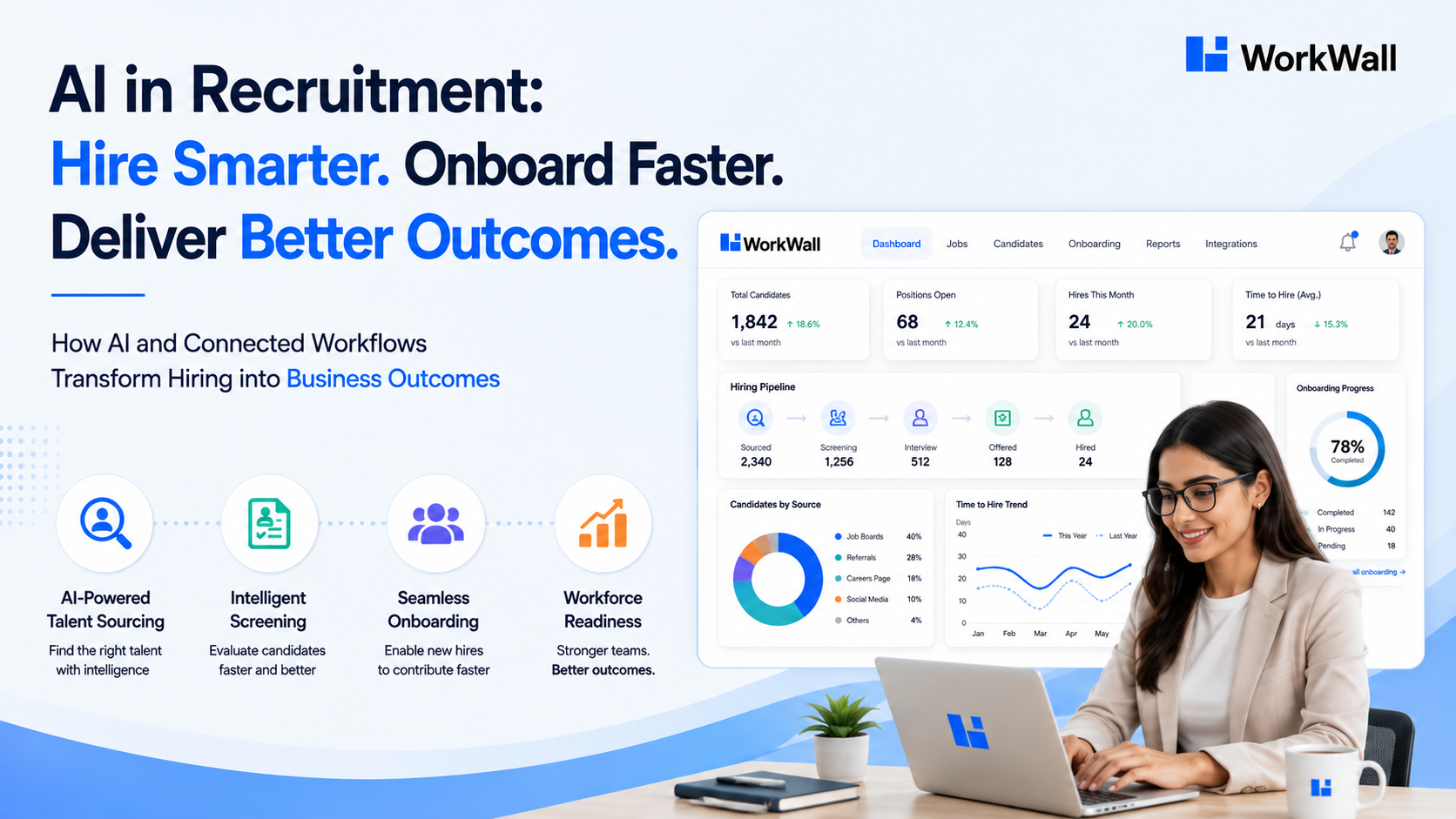
The modern recruitment landscape is evolving faster than ever. Organizations are hiring across global talent pools, managing remote and hybrid workforces, and balancing full-time employees, contractors, and freelancers to meet growing business demands. As hiring becomes more dynamic, recruiters are expected to deliver exceptional candidate experiences while reducing time-to-hire and maintaining the quality of every hiring decision. Artificial Intelligence is helping organizations meet these expectations by streamlining recruitment workflows, surfacing qualified candidates faster, and enabling recruiters to focus on building stronger relationships instead of managing repetitive administrative tasks.

Recruitment has always been about one fundamental goal—finding the right person for the right opportunity.
Yet achieving that goal has never been straightforward.
Recruiters sift through hundreds, sometimes thousands, of applications for a single role. Candidates struggle to present their skills effectively. Hiring managers balance technical expertise with cultural fit, while business leaders expect positions to be filled quickly without compromising quality.
In recent years, Artificial Intelligence (AI) has emerged as one of the biggest forces reshaping this process.
From recommending suitable candidates and analyzing resumes to automating interview scheduling and uncovering hidden talent pools, AI is helping recruitment teams work faster and more efficiently. For job seekers, AI is becoming a valuable assistant for refining resumes, highlighting measurable achievements, tailoring applications to specific roles, and preparing for interviews.
But the true value of AI in recruitment isn't speed alone.
It's helping both recruiters and candidates make better decisions.
A well-written resume doesn't guarantee the right hire, just as reviewing hundreds of applications doesn't always lead to the best candidate. The real advantage of AI lies in its ability to reduce repetitive work, surface meaningful insights, and allow people to focus on what matters most—evaluating skills, potential, and long-term fit.
As recruitment continues to evolve, organizations are beginning to realize that successful hiring isn't driven by automation alone. It depends on creating a connected hiring experience where talent discovery, evaluation, onboarding, and workforce collaboration work together seamlessly.
In this article, we'll explore how AI is transforming recruitment, where its strengths and limitations lie, and why the future of hiring depends not only on intelligent technology but also on connected workflows that turn hiring decisions into successful business outcomes.

Recruitment today looks very different from what it did just a few years ago.
Organizations are no longer hiring only for permanent, office-based roles. Today's workforce includes full-time employees, contractors, freelancers, consultants, remote professionals, and project-based specialists working across multiple locations and time zones. Hiring has become faster, more dynamic, and closely tied to business priorities.
At the same time, the expectations placed on recruitment teams have grown significantly.
Recruiters are expected to source qualified talent quickly, deliver an exceptional candidate experience, collaborate with multiple stakeholders, and ensure hiring decisions align with both immediate project needs and long-term business goals. Balancing speed with quality has become one of the biggest challenges in modern talent acquisition.
Adding to this complexity is the sheer volume of information recruiters need to process. A single job posting can attract hundreds of applications, each requiring careful evaluation beyond keywords on a résumé. Hiring managers expect candidates who possess not only the required technical skills but also the adaptability, collaboration, and problem-solving abilities needed to thrive in evolving work environments.
This is where Artificial Intelligence is beginning to reshape recruitment—not by replacing recruiters, but by helping them navigate complexity more effectively.
Instead of spending valuable hours manually screening resumes or coordinating repetitive administrative tasks, recruiters can use AI to identify relevant candidates, surface meaningful insights, automate routine workflows, and focus more on building relationships with potential hires.
The role of recruitment is evolving from processing applications to making informed hiring decisions.
And that's an important distinction.
The organizations gaining the greatest value from AI aren't simply hiring faster—they're creating recruitment processes that are more data-driven, consistent, and candidate-focused. AI enables recruiters to spend less time managing paperwork and more time understanding people, ensuring that hiring decisions are based on potential, skills, and business fit rather than manual effort alone.
Ultimately, the future of recruitment isn't defined by how much work AI can automate. It's defined by how effectively AI helps recruiters make better decisions while keeping the human element at the center of every hiring journey.
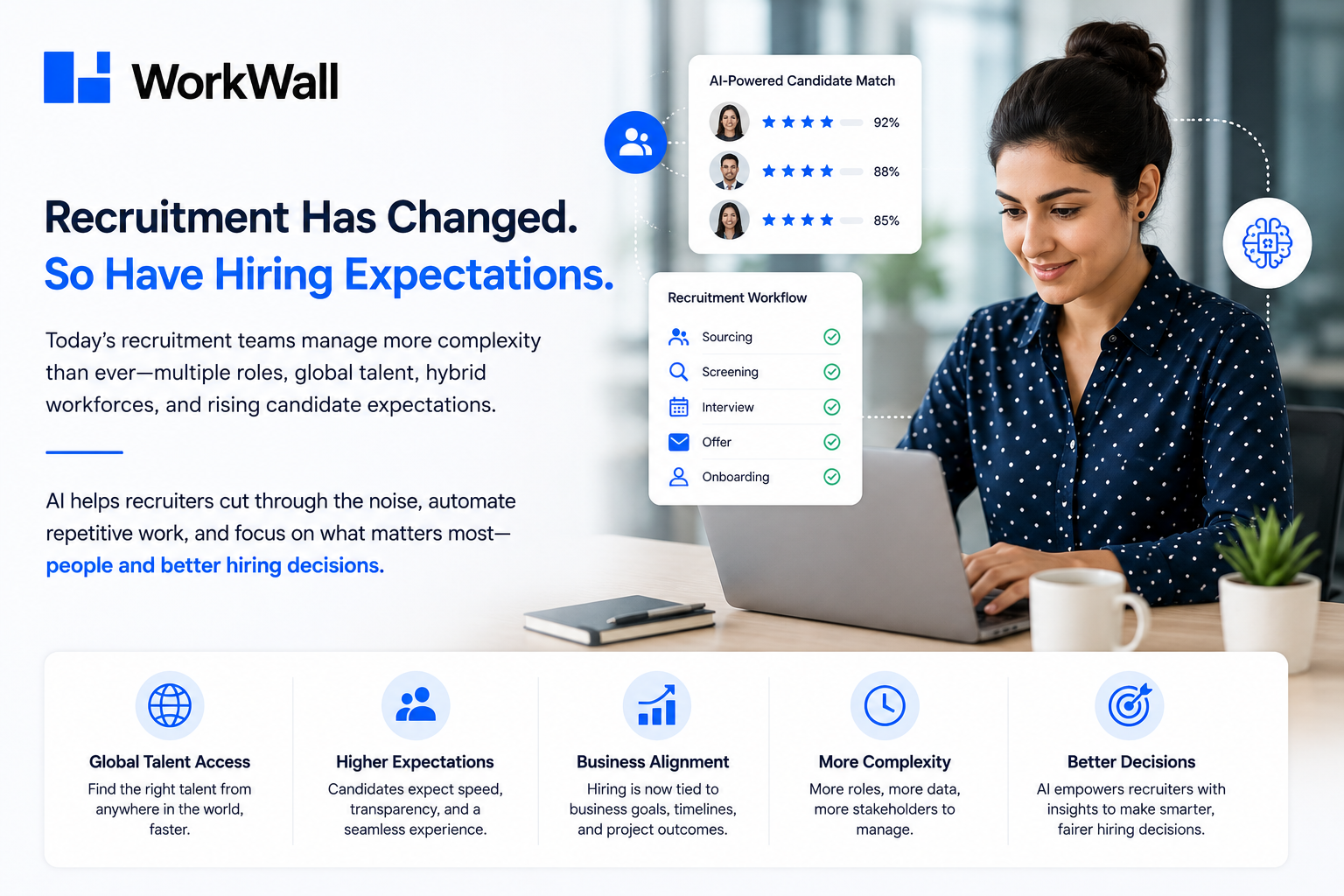
Artificial Intelligence is no longer a futuristic concept in recruitment—it's becoming an integral part of how organizations attract, evaluate, and engage talent. But its value extends far beyond automating repetitive tasks.
The most successful organizations are using AI to make recruitment more intelligent, consistent, and candidate-centric. Rather than replacing human expertise, AI acts as a decision-support system, helping recruiters spend less time on administrative work and more time building meaningful connections with candidates.
Let's explore how AI is reshaping each stage of the hiring journey.
Finding the right candidate has always been one of recruitment's biggest challenges.
Traditional sourcing methods often require recruiters to search across multiple job boards, professional networks, internal databases, and referrals. This process is time-consuming and doesn't always uncover the most relevant talent.
AI simplifies this process by analyzing job requirements, identifying suitable candidates from larger talent pools, and recommending profiles based on skills, experience, certifications, and role compatibility—not just keyword matches.
This enables recruiters to spend less time searching and more time engaging with qualified candidates.
Recruiters often review hundreds of applications for a single position.
Manually screening every resume isn't just time-intensive—it also increases the chances of overlooking qualified candidates.
AI helps prioritize applications by analyzing candidate profiles against predefined job criteria, highlighting relevant skills, career progression, certifications, and experience. Instead of replacing recruiter judgment, AI narrows the focus so hiring teams can evaluate the most relevant candidates more efficiently.
This creates a more structured and consistent screening process while reducing administrative effort.
The candidate experience plays a significant role in attracting top talent.
Delayed responses, missed follow-ups, or inconsistent communication can negatively impact employer branding and candidate satisfaction.
AI-powered recruitment tools help automate routine interactions such as interview scheduling, application updates, and frequently asked questions, ensuring candidates receive timely communication throughout the hiring process.
With repetitive communication handled efficiently, recruiters can focus on personalized conversations that build stronger relationships with potential hires.
Recruitment has traditionally relied on a combination of experience, intuition, and stakeholder feedback.
While these remain important, AI introduces another valuable dimension—data.
By analyzing hiring patterns, recruitment performance, candidate pipelines, and historical outcomes, AI provides insights that help organizations make more informed decisions. Recruiters can better understand sourcing effectiveness, identify hiring bottlenecks, and forecast future talent needs with greater confidence.
The result is a recruitment strategy that's not only faster but also more informed and measurable.
One of the greatest misconceptions about AI is that it's designed to replace recruiters.
In reality, AI is most effective when it removes repetitive, administrative work—not human interaction.
Tasks such as scheduling interviews, organizing candidate information, tracking application statuses, or reviewing large volumes of resumes can consume a significant portion of a recruiter's day. By automating these routine activities, AI creates more time for what recruiters do best: understanding people, assessing potential, building relationships, and making thoughtful hiring decisions.
Technology may improve efficiency, but trust, empathy, and judgment remain distinctly human qualities.
The true value of AI in recruitment isn't measured by how many tasks it automates—it's measured by how much time it gives recruiters to focus on people, make better hiring decisions, and create stronger candidate experiences.
Artificial Intelligence has undoubtedly made recruitment more efficient. It helps organizations source candidates faster, streamline resume screening, automate repetitive tasks, and provide valuable insights throughout the hiring process.
Yet, despite these advancements, many organizations continue to face the same challenge:
Hiring someone doesn't necessarily mean they're ready to contribute.
The recruitment journey doesn't end when a candidate accepts an offer. In many ways, that's where the real work begins.
New hires still need to complete documentation, undergo verification, receive system access, attend onboarding sessions, connect with their teams, understand project expectations, and become familiar with internal processes. These activities often involve HR, IT, compliance, finance, hiring managers, and project teams—all working across different systems and workflows.
If these processes aren't connected, even the most successful recruitment effort can lose momentum.
Many organizations have invested in AI to improve hiring efficiency, but post-hiring operations often remain fragmented.
Candidate information may be stored in one platform, onboarding documents in another, communication happens over emails, approvals are tracked manually, and project allocation is managed separately.
This lack of continuity creates unnecessary friction.
New hires wait for approvals.
Managers spend time following up on pending tasks.
HR teams manually coordinate between departments.
Project teams wait longer to onboard talent.
What begins as a successful recruitment process gradually turns into an operational challenge.
Today's hiring decisions have a direct impact on business performance.
A delayed onboarding process can postpone project delivery.
Incomplete compliance checks can create operational risks.
Poor collaboration between departments can reduce productivity before a new employee even begins contributing.
This is why leading organizations are expanding their focus beyond recruitment.
Instead of optimizing individual stages of hiring, they're creating connected workflows that support the entire employee journey—from talent acquisition to workforce readiness.
The objective is no longer just to hire quickly.
It's to ensure that every new hire can contribute effectively from day one.
AI is incredibly effective at improving decision-making during recruitment.
But long-term hiring success depends on something broader: how well every stage of the workforce journey is connected.
When recruitment, onboarding, compliance, collaboration, and project allocation operate as one continuous process, organizations reduce delays, improve visibility, and create a smoother experience for both employees and hiring teams.
In other words, AI improves recruitment.
Connected workflows improve business outcomes.

Artificial Intelligence has transformed how organizations find and evaluate talent. Recruiters can source candidates faster, reduce manual effort, and make more informed hiring decisions.
But successful recruitment isn't measured by how quickly an offer letter is sent.
It's measured by how quickly the right person becomes productive.
For many organizations, this transition remains one of the biggest operational challenges.
Once a candidate accepts an offer, the hiring process expands beyond recruitment. HR teams begin onboarding, IT provisions system access, managers prepare project assignments, compliance teams complete verification, and business leaders expect new hires to contribute without delay.
These activities are often managed across multiple systems, spreadsheets, emails, and disconnected workflows.
While each team completes its individual responsibilities, the organization lacks visibility into the overall journey.
As a result, recruiters don't know where onboarding has stalled.
Managers don't know when talent will become available.
Project teams struggle to plan effectively.
And candidates experience unnecessary delays before they can start contributing.
This is why forward-thinking organizations are moving beyond isolated recruitment tools toward connected workforce management.
Instead of treating recruitment, onboarding, compliance, workforce planning, and project allocation as separate processes, they are bringing them together into one connected ecosystem that enables information to flow seamlessly across teams.
The goal is no longer simply to hire faster.
It's to ensure that every hiring decision translates into business value as quickly as possible.
This is where WorkWall makes a meaningful difference.
Rather than functioning as just another recruitment platform, WorkWall connects the entire workforce lifecycle—from discovering talent to onboarding, collaboration, compliance, workforce management, and project readiness.
By bringing these processes together into a single connected ecosystem, organizations gain complete visibility into what happens after a hiring decision is made.
Instead of manually coordinating across multiple teams and tools, recruiters, hiring managers, HR professionals, and business leaders work from a shared platform that keeps everyone aligned throughout the hiring journey.
With WorkWall, organizations can:
Manage employees, contractors, vendors, and project resources from one unified platform instead of relying on disconnected systems.
Reduce delays by streamlining documentation, approvals, onboarding workflows, and workforce readiness activities.
Connect HR, hiring managers, IT, finance, compliance, and project teams through shared workflows and real-time visibility.
Track progress across every stage of the workforce journey—from candidate selection to project allocation—allowing teams to identify bottlenecks before they impact productivity.
Hiring doesn't create business value.
People do.
WorkWall helps organizations shorten the gap between recruitment and meaningful contribution by ensuring new hires have everything they need to become productive faster.

Discover Workday's approach to enhancing HR agility, ensuring your organization remains resilient and responsive in today's ever-changing work environment.

Discover how Workday’s reporting and analytics tools can help organizations gain real-time, actionable insights, driving smarter decision-making and business growth.

Explore how Workday is reshaping the ERP landscape with its innovative cloud-based solutions that unify HR, finance, and operations to drive efficiency and scalability.

Planning a Workday upgrade or new rollout? Learn how to build a solid business case that gets leadership on board and secures the resources you need.


Workday is live — now what? Learn how to go beyond "just working" and turn Workday into a powerful growth enabler.

Wondering if your Workday system can keep up as your business expands? Learn how to spot limitations, avoid rework, and scale smarter.

Explore whether your Workday setup can handle fast growth without becoming a tech burden. Practical insights and tips await.

Explore how AI is transforming staffing by creating smarter, faster, and more accurate talent matches that go beyond just resumes.
Stay ahead of the tech curve! Subscribe to our weekly newsletter for a curated dose of the latest industry insights, project highlights, and exclusive updates.