


.png)
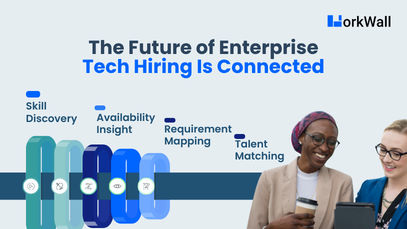
Hiring technology talent has never been more critical—or more complex. While organizations can source skilled freelancers from almost anywhere, integrating them into existing business processes remains a significant challenge. Manual onboarding, disconnected collaboration tools, compliance bottlenecks, and fragmented workflows often delay productivity and increase operational overhead. Modern enterprises need more than a marketplace—they need connected workforce platforms that integrate talent directly into the systems where work happens, enabling faster onboarding, stronger governance, and seamless project execution.

Hiring technology talent has never been more critical—or more complex.
As organizations accelerate digital transformation, the demand for specialized skills in cloud computing, AI, cybersecurity, ERP, data engineering, and enterprise application development continues to grow. Yet finding the right expertise is only part of the challenge. The real test begins after the hiring decision is made.
For many enterprises, onboarding freelancers and external vendors still involves fragmented processes. Access requests are managed through email, contracts are stored across multiple systems, project information is shared manually, and collaboration often begins days—or even weeks—after a contractor is selected. What should be a seamless extension of the workforce quickly becomes an administrative burden.
The problem isn't a shortage of talent.
It's the disconnect between hiring talent and integrating that talent into the organization's operational ecosystem.
Traditional freelance marketplaces were designed to help businesses find independent professionals. They were never built to support enterprise-scale delivery where external teams must collaborate securely through platforms like Workday, Slack, GitHub, Jira, Microsoft Teams, and other business-critical applications.
Today's enterprises expect more than a marketplace.
They need a connected talent ecosystem where onboarding, collaboration, compliance, project delivery, and financial operations work together from day one.
This shift is giving rise to a new generation of API-integrated freelance platforms—platforms designed not simply to connect businesses with skilled professionals, but to integrate external talent directly into enterprise workflows. The result is faster onboarding, greater operational visibility, stronger governance, and a more scalable approach to building distributed technology teams.
For organizations navigating rapid growth and increasingly complex technology initiatives, the future of freelance hiring isn't about finding more talent. It's about enabling that talent to contribute from the moment they join.

The way enterprises hire external talent has fundamentally changed. Hiring is no longer an isolated process that ends when a contract is signed—it is the beginning of a collaborative journey that spans onboarding, project execution, communication, governance, compliance, and payment.
Traditional freelance marketplaces were built to help organizations discover talent. Modern enterprises, however, need platforms that do much more. They need solutions capable of integrating external professionals directly into their existing technology ecosystem, enabling them to work as seamlessly as internal teams.
This is where API-integrated freelance platforms are redefining enterprise workforce management.
Rather than operating as standalone marketplaces, these platforms connect with the business applications organizations already rely on every day. Through secure integrations with tools such as Workday, Slack, GitHub, Jira, Microsoft Teams, Zoom, ERP systems, and HR platforms, they automate repetitive administrative tasks and create a unified experience for both employers and freelancers.
The result is a hiring process that feels less like bringing in an outsider and more like extending your existing workforce.
A developer can receive system access automatically after contract approval. A consultant can be added to the appropriate Slack channels, assigned Jira tickets, granted GitHub repository permissions, and begin collaborating on day one—all without lengthy email chains or manual coordination.
For enterprise leaders, this means reduced operational friction, stronger governance, improved visibility, and significantly faster project execution. Instead of managing disconnected tools and processes, teams can focus on delivering outcomes while the platform orchestrates the operational workflows behind the scenes.
API-integrated freelance platforms are not simply improving recruitment—they are creating connected talent ecosystems where people, processes, and technology work together from the very beginning.
For years, freelance marketplaces have made it easier to connect businesses with independent professionals. They simplified talent discovery, expanded access to global expertise, and accelerated project-based hiring.
But as enterprise projects have become larger, more complex, and increasingly integrated with digital business operations, the expectations placed on freelance platforms have evolved.
Today, organizations aren't just hiring individuals to complete isolated tasks. They're engaging cloud architects to modernize infrastructure, ERP consultants to implement business-critical systems, AI specialists to build intelligent applications, and development teams to deliver enterprise-scale software. These professionals often work alongside internal employees, technology vendors, and cross-functional business units.
Managing this level of collaboration requires far more than a freelancer directory.
Enterprise leaders now expect hiring platforms to provide governance, visibility, security, and operational continuity throughout the entire project lifecycle—from sourcing and contracting to onboarding, delivery, compliance, and payment.
Traditional marketplaces typically focus on matching buyers with freelancers. Once the engagement begins, organizations are left to manage communication, documentation, access provisioning, project tracking, and compliance across multiple disconnected systems.
Modern API-integrated marketplaces eliminate these operational gaps by embedding freelance talent directly into enterprise workflows. Instead of treating external professionals as temporary resources working outside the organization, they become connected contributors operating within the same collaboration, security, and delivery framework as internal teams.
This shift reduces administrative overhead, accelerates productivity, improves transparency, and enables organizations to scale distributed teams with greater confidence.
The question for enterprise leaders is no longer where to find skilled professionals.
It's how quickly those professionals can become productive while operating securely inside the business ecosystem.
Enterprise hiring isn't measured by how quickly a freelancer is selected. It's measured by how quickly that person begins delivering meaningful business outcomes.
Every day spent waiting for contracts, system access, project documentation, or onboarding approvals delays project milestones and increases operational costs. At enterprise scale, these delays multiply across dozens—or even hundreds—of external contributors, creating unnecessary friction throughout the organization.
API-driven talent ecosystems eliminate these inefficiencies by connecting every stage of the workforce lifecycle into a single, intelligent workflow.
Instead of manually coordinating multiple systems, organizations can automate onboarding, synchronize collaboration tools, streamline project delivery, and manage compliance from one connected platform. External professionals gain immediate access to the resources they need, project managers receive real-time visibility into delivery progress, and leadership benefits from centralized reporting across distributed teams.
The result is more than operational efficiency—it is a workforce that can scale rapidly without sacrificing governance, security, or collaboration.
As organizations continue to embrace hybrid delivery models, API-powered platforms provide the foundation for building agile, connected teams capable of responding to changing business priorities faster than ever before.
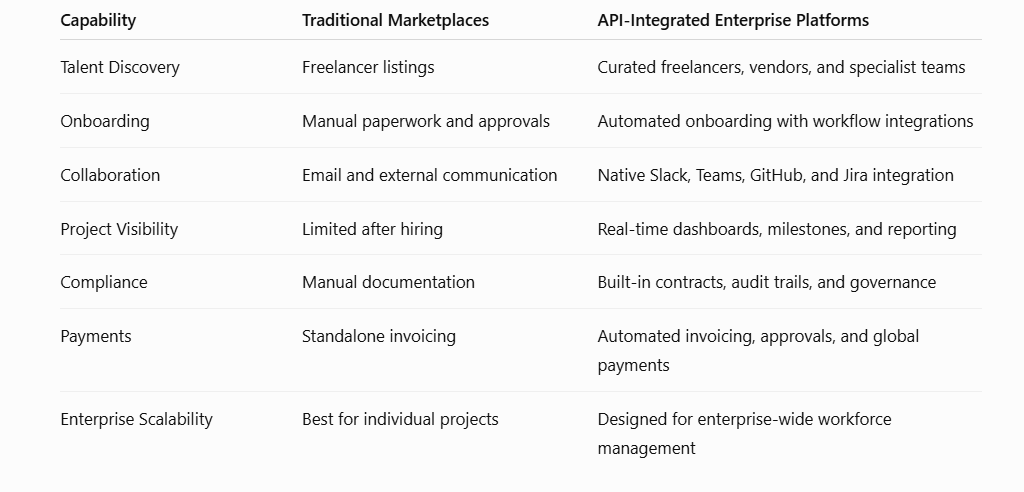
Automated onboarding workflows significantly reduce the time between hiring and project execution. Contractors receive the right access, documentation, and project assignments from day one, enabling them to contribute immediately.
Native integrations with platforms such as Slack, Microsoft Teams, GitHub, Jira, and Zoom create a unified working environment where internal employees, vendors, and freelancers collaborate seamlessly without switching between disconnected systems.
Centralized dashboards provide real-time insights into project milestones, resource utilization, delivery progress, vendor performance, and workforce capacity, enabling better decision-making at every stage of the project lifecycle.
Integrated contract management, audit trails, automated approvals, and standardized workflows help organizations maintain compliance while reducing administrative overhead and minimizing operational risk.
Whether onboarding five specialists or managing hundreds of external professionals across multiple regions, API-driven platforms enable organizations to scale confidently while maintaining consistent processes and governance.
As enterprises move toward integrated workforce strategies, they need more than a marketplace to source freelancers. They need a platform that brings together talent discovery, vendor collaboration, project execution, compliance, and enterprise integrations into one connected ecosystem.
WorkWall was built with this vision in mind.
Rather than functioning as a traditional freelance marketplace, WorkWall enables organizations to discover, onboard, manage, and collaborate with freelancers, specialized vendors, and technology partners through a unified enterprise platform. Every engagement is designed to fit naturally within existing business workflows, allowing external teams to become productive from the moment they join.
Whether an organization is hiring a cloud architect for a Microsoft Azure migration, an Oracle consultant for an ERP implementation, an AI engineer for a machine learning initiative, or a development team to build enterprise applications, WorkWall simplifies every stage of the engagement lifecycle.
By integrating with enterprise collaboration, project management, and business applications, WorkWall helps eliminate manual handoffs that often delay project delivery. Teams can collaborate through familiar tools, automate onboarding processes, manage contracts, monitor project progress, and streamline invoicing—all from a connected environment designed for enterprise delivery.
Instead of treating freelancers as temporary external resources, WorkWall enables organizations to build an extended workforce that operates with the same visibility, governance, and operational efficiency as internal teams.
Access a curated ecosystem of freelancers, implementation partners, consulting firms, and technology vendors with proven expertise across cloud, AI, ERP, cybersecurity, data engineering, and software development.
Integrate seamlessly with enterprise collaboration and project management tools to accelerate onboarding, improve communication, and reduce operational friction.
Manage independent professionals, consulting partners, and specialized agencies within a single platform while maintaining centralized visibility across projects and deliverables.
Automate contracts, approvals, compliance workflows, invoicing, and documentation to support enterprise-grade governance without increasing administrative complexity.
Track milestones, resource utilization, delivery progress, and vendor performance through centralized dashboards that empower project managers and business leaders with real-time insights.
Imagine an enterprise launching a global ERP modernization initiative.
Instead of sourcing talent across multiple marketplaces and coordinating onboarding through emails and spreadsheets, the hiring team publishes the project on WorkWall.
Within hours, qualified implementation partners and independent specialists submit proposals tailored to the project's technical and business requirements.
Once selected, contracts are initiated, onboarding workflows are triggered, collaboration channels are established, and project access is provisioned through integrated enterprise systems. Teams begin planning, development, testing, and delivery without the delays typically associated with external hiring.
Project managers gain real-time visibility into milestones, leadership monitors delivery through centralized dashboards, and finance teams benefit from streamlined invoicing and compliance—all within a unified platform.
The result is not just faster hiring, but a connected delivery model that enables organizations to execute complex technology initiatives with greater confidence, efficiency, and control.
Enterprise Insight:
The future of workforce management isn't about managing freelancers separately. It's about creating one connected ecosystem where employees, vendors, and independent professionals collaborate seamlessly toward shared business outcomes.
The way organizations hire technology talent is undergoing a fundamental transformation.
Traditional freelance marketplaces helped businesses access a global talent pool, but enterprise workforce management now demands much more than talent discovery. Modern organizations require hiring models that prioritize speed, collaboration, governance, and seamless integration with the systems that power everyday operations.
API-integrated freelance platforms represent the next evolution of enterprise hiring. By connecting external professionals directly with collaboration tools, project management systems, HR platforms, and financial workflows, these platforms eliminate operational friction and create a unified experience for everyone involved.
The result is a workforce that is faster to onboard, easier to manage, and better equipped to deliver business outcomes from day one.
For enterprise leaders, this shift isn't simply about adopting new technology—it's about building a workforce strategy that can adapt to changing business demands. As digital transformation accelerates and specialized skills become increasingly distributed, organizations that embrace connected talent ecosystems will be better positioned to innovate, scale globally, and execute complex initiatives with confidence.
Platforms like WorkWall are helping make this future a reality by bringing together enterprise-ready talent, intelligent integrations, and end-to-end workforce management within a single ecosystem. Instead of managing disconnected hiring processes, organizations can create a collaborative environment where employees, vendors, and independent professionals work together seamlessly toward shared business goals.
The future of enterprise hiring isn't about finding more freelancers.
It's about building an intelligent workforce ecosystem where talent, technology, and business processes operate as one.
Whether you're scaling a digital transformation initiative, expanding your engineering capacity, or looking for specialized technology expertise, the right platform can make the difference between managing contractors and building a high-performing, connected workforce.
WorkWall empowers enterprises to discover trusted technology professionals, streamline onboarding, automate operational workflows, and manage projects through one unified ecosystem—helping organizations move faster while maintaining the governance, visibility, and control modern enterprises demand.
Build your connected workforce with WorkWall—and transform the way your enterprise hires, collaborates, and delivers.


Discover how Workday connects your data dots, helping you make faster, smarter decisions—without the spreadsheet chaos.

Say goodbye to outdated forecasts. Workday helps you embrace continuous planning to keep your finance team fast, flexible, and future-ready.
Transform your workplace vibe. See how Workday creates meaningful employee experiences that keep your top talent loyal and thriving.

Discover how Workday's automation capabilities enhance operational efficiency by reducing manual tasks and improving accuracy across workflows.

Discover how CIOs can lead the charge in digital transformation by utilizing Workday’s cloud-based solutions to enhance agility, innovation, and data-driven decision-making.

Learn how Workday helps organizations remain agile, adapting to changing business environments with real-time solutions and flexible processes

Explore how Workday’s contract intelligence tools are transforming contract management through AI, automation, and improved collaboration..

Explore how Workday’s learning and development solutions help organizations build a future-ready workforce by promoting continuous learning, upskilling, and talent development.
Stay ahead of the tech curve! Subscribe to our weekly newsletter for a curated dose of the latest industry insights, project highlights, and exclusive updates.