


.png)
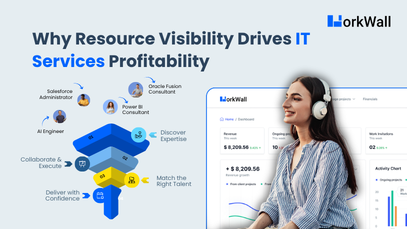
Most IT services firms measure growth through revenue, project wins, and headcount. Yet one of the biggest drivers of profitability often goes unnoticed: resource utilization. Every unassigned consultant represents more than idle capacity—it represents delayed revenue, missed opportunities, and lower returns on the investment made in hiring, training, and developing skilled professionals. The challenge isn't a shortage of talent. It's knowing where expertise exists and how quickly it can be deployed.

Winning more projects should lead to higher profits.
Yet for many IT services firms, the opposite is happening.
Revenue is growing. Demand for digital transformation continues to rise. Clients are investing in cloud migrations, AI initiatives, ERP implementations, cybersecurity, and enterprise modernization. On paper, the outlook looks promising.
So why are margins becoming harder to protect?
The answer often isn't rising salaries, increasing competition, or economic uncertainty. It's something far less visible—and far more expensive.
Idle expertise.
Across IT services organizations, highly skilled consultants spend days or even weeks between projects. Some wait for the right opportunity. Others remain on the bench because managers don't have real-time visibility into their availability or skills. In many cases, project teams are searching externally for specialists while equally qualified professionals inside the organization remain underutilized.
This isn't just an operational inefficiency.
It's a profitability problem.
Every day a consultant sits idle, the business absorbs more than just salary costs. It loses billable hours, delays revenue recognition, slows project delivery, and reduces the return on every investment made in hiring, training, and retaining skilled talent. These hidden costs accumulate quietly until they begin to show up where leadership pays the closest attention: shrinking margins.
The challenge is becoming even more significant as enterprise projects grow increasingly specialized. Clients no longer need generalists—they need experts in Microsoft Dynamics 365, Oracle Cloud, Salesforce, Azure, AI, cybersecurity, and dozens of other niche technologies. At the same time, delivery timelines are getting shorter, making it critical for organizations to deploy the right expertise as soon as opportunities arise.
This shift is changing how successful IT services firms think about growth.
Instead of asking, "How many consultants do we have?", they're asking a more important question:
"How quickly can we turn available expertise into billable work?"
That question is redefining resource utilization as one of the most important drivers of profitability in modern IT services.
In this article, we'll explore why idle consultants are costing businesses more than they realize, how poor resource utilization affects growth and margins, and what leading organizations are doing differently to ensure their expertise is always creating value.
When IT services leaders review their financial performance, they usually focus on familiar metrics—revenue growth, sales pipeline, project wins, and operating costs. These numbers offer a snapshot of how the business is performing, but they don't always explain why profitability changes over time.
One of the biggest reasons often goes unnoticed.
Imagine two IT services firms with nearly identical revenue.
Both have strong client relationships, experienced consultants, and a steady pipeline of enterprise projects. Yet one consistently delivers higher profit margins than the other.
The difference isn't the number of clients they serve or the rates they charge.
It's how effectively they use the talent they already have.
In professional services, people are the business. Every consultant represents knowledge, delivery capability, and revenue potential. But that value only materializes when expertise is actively contributing to client work. The moment highly skilled professionals spend extended periods without billable assignments, the financial impact begins—even if it isn't immediately visible on a dashboard.
Unlike manufacturing businesses, where idle machinery is easy to identify, unused expertise is much harder to spot. Consultants still attend meetings, complete internal training, support documentation, or prepare for future projects. While these activities have value, they don't generate billable revenue. Over time, even small gaps between projects can accumulate into significant losses across a growing organization.
Consider a consulting firm with 200 technical professionals. If just 10% of its workforce remains unassigned for a month, that's 20 specialists whose expertise isn't generating client value. The organization continues to cover salaries, benefits, software licenses, certifications, and operational overhead, yet the expected return on that investment is delayed. Scale that across multiple business units or over several quarters, and the effect on margins becomes difficult to ignore.
This is why leading IT services firms no longer evaluate success by headcount alone. They measure how efficiently expertise moves from availability to billable work.
In today's market, profitability isn't determined solely by winning more projects. It's determined by how quickly organizations can match the right skills to those opportunities.
And that's where many firms begin to lose momentum—not because demand is lacking, but because visibility into available expertise is.
When people talk about consultants sitting on the bench, the conversation almost always begins with payroll.
"We're paying salaries without generating revenue."
While that's true, it's also an oversimplification.
The real cost of idle talent isn't the monthly paycheck. It's the chain reaction that begins the moment expertise is no longer contributing to billable work.
Every consultant is an investment—not just in compensation, but in recruitment, onboarding, certifications, technical training, software licenses, mentorship, and years of accumulated experience. The expectation is that this investment will translate into client outcomes and sustainable revenue. When that expertise remains underutilized, the return on that investment begins to decline.
More importantly, idle consultants don't simply increase costs—they reduce earning potential.
An experienced Microsoft Dynamics 365 consultant, Oracle Cloud architect, Salesforce specialist, or Azure engineer has a finite number of billable hours available each year. Every week without a client assignment is a week of revenue that cannot be recovered later. Unlike manufacturing output, billable consulting hours cannot be stored and sold in the future. Once that time passes, the opportunity is gone.
This creates a hidden financial challenge for IT services firms. Leadership teams often focus on reducing operational expenses while overlooking the revenue that was never realized because valuable expertise wasn't deployed at the right time.
And that is where margins begin to erode.
The impact of idle consultants extends far beyond utilization reports. It affects nearly every aspect of the business.
The most immediate consequence is the loss of billable hours.
Every unassigned consultant represents capacity that could have been delivering value to a client. Over weeks or months, those missed hours translate into substantial unrealized revenue—especially in organizations with large consulting teams.
When the right expertise isn't visible or available at the right moment, projects often start later than planned.
Delivery teams spend valuable time searching for resources, reassigning consultants, or hiring externally. What begins as a staffing delay can quickly impact project timelines, client expectations, and future business opportunities.
Highly skilled professionals want to solve meaningful business problems.
Extended periods without client work can reduce motivation, slow professional development, and increase the likelihood that top performers begin exploring opportunities elsewhere.
For organizations already facing a competitive talent market, losing experienced consultants creates an additional cycle of recruitment costs and knowledge loss.
Resource planning becomes increasingly difficult when availability is tracked across disconnected spreadsheets, emails, and manual updates.
Without accurate visibility into who is available—and when—forecasting future capacity becomes more reactive than strategic. This uncertainty affects hiring decisions, sales planning, and delivery commitments.
Perhaps the greatest cost is the opportunity that never materializes.
Sales teams may hesitate to pursue new projects because they aren't confident the required expertise can be mobilized quickly. At the same time, capable consultants remain underutilized simply because no one has a complete view of available skills across the organization.
Growth slows—not because demand is lacking, but because resource deployment cannot keep pace with business opportunities.
For many IT services firms, the instinctive response to growing demand is to hire more people.
But sustainable growth doesn't come from increasing headcount alone.
It comes from ensuring that existing expertise is consistently aligned with the right projects, at the right time.
The firms with the healthiest margins are often not the ones with the largest teams. They're the ones with the strongest visibility into their talent, the fastest resource allocation processes, and the ability to convert available expertise into billable work with minimal delay.
In other words, profitability today is less about how many consultants you employ—and more about how effectively you deploy them.
If the financial impact of idle consultants is so significant, why do so many IT services firms continue to struggle with resource utilization?
The answer isn't a lack of talent.
It's a lack of visibility.
As consulting organizations grow, the complexity of managing people grows with them. New projects begin every week, consultants move between accounts, clients request niche expertise at short notice, and delivery priorities shift constantly. What may have worked for a 50-person consulting firm quickly becomes difficult to manage across hundreds or thousands of professionals.
Yet many organizations continue to rely on fragmented processes to answer one of their most important operational questions:
Who is available, what skills do they have, and where should they be deployed next?
The information exists—but it's rarely connected.
Project managers maintain their own resource trackers.
HR teams manage employee records in separate systems.
Sales teams forecast upcoming opportunities through CRM platforms.
Delivery leaders monitor project status using entirely different tools.
Availability is often updated manually, shared through emails, or discussed in weekly resource meetings. By the time everyone agrees on the latest information, the reality has already changed.
The result is a business operating with delayed visibility.
A consultant may become available today, but sales doesn't know until next week.
A project may urgently require an Azure specialist, while another business unit has someone with exactly that expertise finishing an engagement tomorrow.
A partner organization may be searching externally for a Microsoft Dynamics consultant while another trusted partner has the required capability sitting idle.
The challenge isn't a shortage of expertise.
It's the inability to connect expertise with opportunity before time—and revenue—is lost.
Traditional resource planning assumed that projects followed predictable timelines and consultants stayed with the same client for extended periods.
Today's consulting landscape looks very different.
Projects start faster.
Technology stacks evolve continuously.
Clients expect specialists—not generalists.
Hybrid and remote delivery have expanded the talent pool beyond geographic boundaries.
At the same time, organizations are balancing full-time employees, contractors, partner resources, and independent specialists across multiple regions and technologies.
Managing this level of complexity through spreadsheets or disconnected systems is no longer sustainable.
Resource utilization has evolved from an operational scheduling exercise into a real-time business capability.
The firms that consistently deliver stronger margins are those that can answer three critical questions instantly:
Organizations that answer these questions quickly don't just improve utilization.
They respond faster to clients, staff projects with greater confidence, reduce unnecessary hiring, and create a more predictable path to growth.
For years, IT services firms invested heavily in recruiting.
Hiring more consultants was seen as the primary way to increase delivery capacity.
But in today's market, the organizations creating the greatest competitive advantage aren't necessarily hiring faster.
They're deploying existing expertise more intelligently.
When businesses have real-time visibility into their talent ecosystem, they stop treating resource allocation as an administrative task and start using it as a strategic lever for growth.
That's the point where resource utilization stops being a metric on a dashboard—and becomes a driver of profitability.
For years, IT services firms have invested in resource management.
They've implemented project management software, workforce planning tools, timesheet systems, HR platforms, and resource allocation spreadsheets. These systems have helped teams organize work, track utilization, and manage delivery operations more efficiently.
But despite having more tools than ever before, many organizations still struggle to answer one simple question:
Where is the right expertise when we need it?
That's because most resource management systems were designed to record information—not generate intelligence.
They tell you who is currently assigned to a project.
They show submitted timesheets.
They display utilization reports after work has already happened.
But they rarely help leaders anticipate what's coming next.
They don't proactively identify consultants who will become available in two weeks.
They don't surface underutilized specialists across different business units.
They don't connect delivery teams with trusted partners who already have the required expertise.
And they certainly don't help leadership understand where future revenue opportunities might be constrained by a shortage—or surplus—of specific skills.
In today's consulting landscape, that level of visibility is no longer optional.
It's becoming a competitive advantage.
The conversation is shifting.
Leading IT services firms are no longer asking,
"How do we manage our people?"
They're asking,
"How do we make better decisions about our people?"
That distinction is more important than it seems.
Managing resources is operational.
Resource intelligence is strategic.
It combines skills visibility, project demand, consultant availability, partner ecosystems, and delivery priorities into a single view—allowing leaders to make informed decisions before problems affect revenue or client delivery.
Imagine a sales team winning a large Microsoft Dynamics 365 implementation.
Instead of beginning a frantic search for consultants, leadership already knows:
That isn't simply better resource management.
It's better business planning.
One of the biggest differences between high-performing consulting firms and average-performing ones isn't the size of their workforce.
It's how quickly they respond to change.
Projects accelerate.
Client priorities shift.
New technologies emerge.
Unexpected opportunities appear.
Organizations with fragmented resource information spend valuable time searching for answers.
Organizations with complete visibility spend that same time delivering value.
The result is faster staffing, improved utilization, better forecasting, and greater confidence when pursuing new business.
In an industry where speed directly influences revenue, visibility becomes more than an operational benefit.
It becomes a growth strategy.
The consulting industry isn't facing a talent shortage as much as it's facing an expertise visibility challenge.
Across organizations, thousands of highly skilled professionals are available, finishing projects, or working below capacity. At the same time, delivery teams are delaying projects because they believe the required expertise isn't available.
Those two realities exist simultaneously because information remains fragmented.
The firms that solve this challenge won't necessarily hire more consultants.
They'll simply become better at discovering, mobilizing, and deploying the expertise they already have—whether it exists within their own organization or across trusted partner networks.
That is the next evolution of resource utilization.
It's no longer about maximizing billable hours.
It's about maximizing the value of expertise.
For years, growth in the IT services industry followed a predictable formula.
Win more clients.
Hire more consultants.
Expand delivery capacity.
Repeat.
That model worked when projects lasted years, technology changed gradually, and businesses could plan their workforce months in advance.
Today's reality is very different.
Enterprise clients expect faster delivery.
Technology stacks evolve continuously.
Specialized skills have become more valuable than general experience.
And project demand can change overnight.
In this environment, competitive advantage isn't determined by the size of your workforce.
It's determined by how quickly your organization can identify, mobilize, and deploy the right expertise.
This is where many firms unknowingly limit their own growth.
They're not struggling because they lack talented people.
They're struggling because they lack visibility into the talent they already have.
Without that visibility:
The outcome isn't just operational complexity.
It's slower growth.
Higher delivery costs.
Lower profitability.
And missed opportunities that competitors are often quicker to capture.
The firms leading the next generation of IT services are approaching workforce strategy differently.
Instead of asking,
"How do we hire more people?"
they're asking,
"How do we make every expert more discoverable, every resource decision more informed, and every opportunity easier to deliver?"
That shift—from managing people to creating visibility across talent, projects, partners, and demand—is what enables organizations to scale without proportionally increasing overhead.
Because when expertise becomes visible, decisions become faster.
Projects start sooner.
Consultants spend more time creating value.
Clients experience better outcomes.
And profitability improves—not through cost-cutting, but through smarter execution.
Modern IT services firms need more than another project tracker or contractor management tool. They need a connected view of their workforce and partner ecosystem—one that helps them respond to opportunities with confidence.
WorkWall is designed to support that shift by bringing together the elements that are often scattered across multiple systems:
The objective isn't simply to reduce bench time.
It's to ensure that expertise is consistently connected to opportunity—whether that opportunity exists within your organization or across your broader partner network.
For IT services firms navigating increasing delivery complexity, better resource visibility isn't just an operational improvement.
It's becoming a strategic capability that supports faster growth, stronger client relationships, and healthier margins.
Every IT services leader wants higher margins.
Many focus on increasing sales, reducing costs, or hiring faster.
Those initiatives matter—but they address only part of the equation.
The organizations that consistently outperform their competitors understand that profitability is also shaped by how effectively expertise is deployed.
Every consultant represents knowledge, experience, and the potential to create value. When that expertise remains idle, businesses lose far more than billable hours. They lose momentum, delay client outcomes, and limit future growth.
As technology projects become more specialized and customer expectations continue to rise, organizations can no longer afford to rely on disconnected systems or manual resource planning.
The future belongs to firms that can see their expertise clearly, deploy it quickly, and adapt to change with confidence.
Because in today's consulting landscape, the most valuable resource isn't talent alone.
It's knowing exactly where that talent can create the greatest impact.


Discover how Workday connects your data dots, helping you make faster, smarter decisions—without the spreadsheet chaos.

Say goodbye to outdated forecasts. Workday helps you embrace continuous planning to keep your finance team fast, flexible, and future-ready.
Transform your workplace vibe. See how Workday creates meaningful employee experiences that keep your top talent loyal and thriving.

Discover how Workday's automation capabilities enhance operational efficiency by reducing manual tasks and improving accuracy across workflows.

Discover how CIOs can lead the charge in digital transformation by utilizing Workday’s cloud-based solutions to enhance agility, innovation, and data-driven decision-making.

Learn how Workday helps organizations remain agile, adapting to changing business environments with real-time solutions and flexible processes

Explore how Workday’s contract intelligence tools are transforming contract management through AI, automation, and improved collaboration..

Explore how Workday’s learning and development solutions help organizations build a future-ready workforce by promoting continuous learning, upskilling, and talent development.
Stay ahead of the tech curve! Subscribe to our weekly newsletter for a curated dose of the latest industry insights, project highlights, and exclusive updates.