


.png)
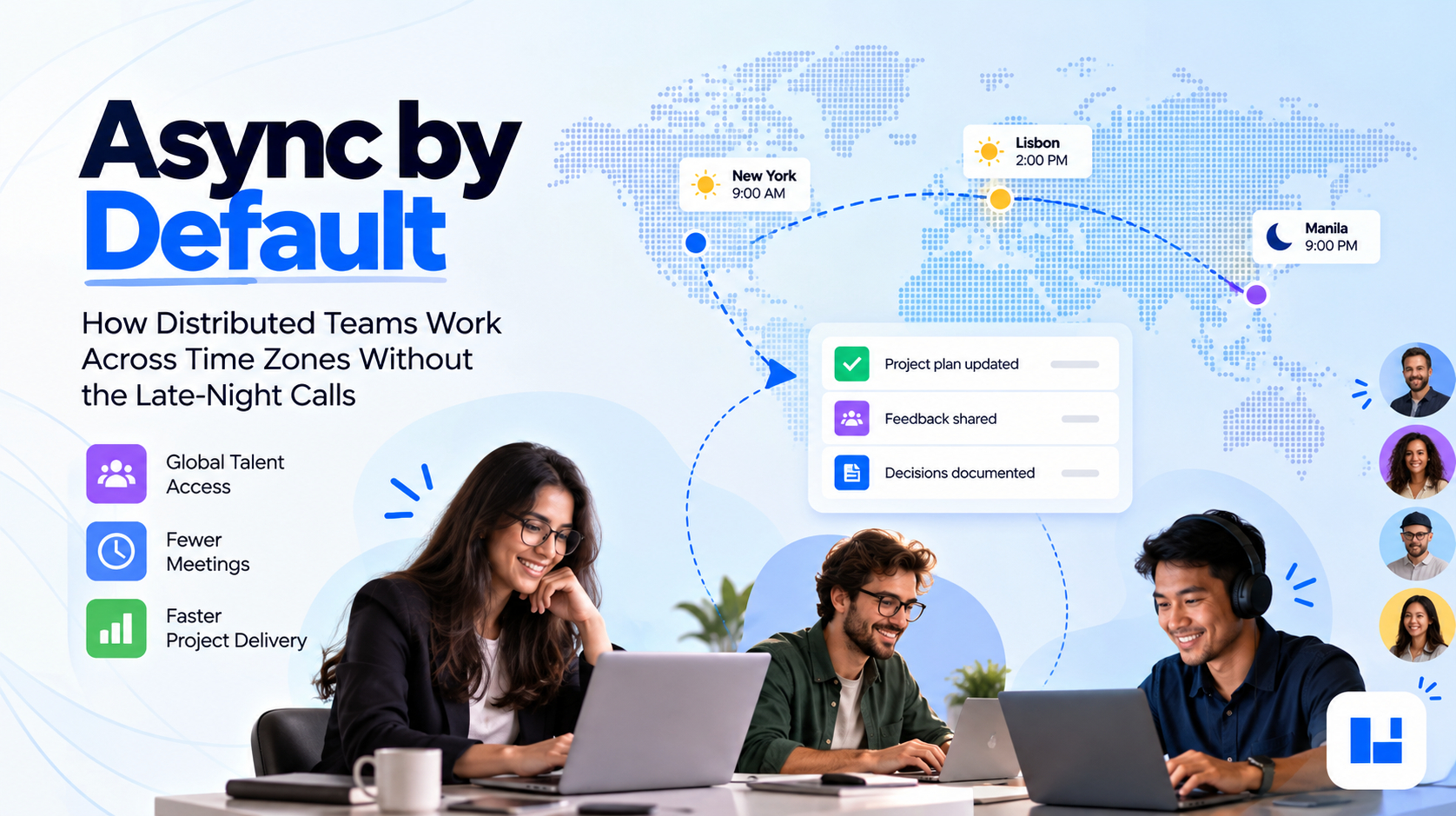
Because most collaboration habits were built for people sitting in the same room, or at least the same working hours. Daily stand-ups. Live brainstorms. "Let's just hop on a call". These habits carry over by default into distributed teams, long after the assumptions that made them efficient have stopped being true. The result is predictable. Meetings scheduled around whoever has the least convenient time zone. Decisions that only move forward when the right three people happen to be awake at once. Momentum that quietly depends on someone, somewhere, staying up late. The problem isn't distance. The problem is designing collaboration as if distance doesn't exist.
.png)

In this article, we'll explore why traditional collaboration models break down across time zones, the practical habits that make async teams successful, and how businesses can build distributed teams that move faster without relying on late-night calls and constant meetings.
An occasional late-night call isn't the real problem. The real problem is the hidden operational cost of relying on synchronous collaboration in a distributed environment.
When teams depend on overlapping working hours to make decisions, progress naturally slows down. A four-hour overlap window becomes the bottleneck for approvals, feedback, and problem-solving, regardless of whether the work itself requires real-time discussion. Instead of work moving continuously across time zones, it starts and stops based on who happens to be online.
The impact extends beyond productivity. Teams often begin making hiring decisions based on availability rather than capability. Highly skilled professionals are overlooked simply because their time zone makes coordination less convenient, limiting access to the global talent pool that distributed work was supposed to unlock in the first place.
There's also a human cost that organizations frequently underestimate. In many distributed teams, the burden of inconvenient meeting times falls on the same individuals repeatedly—often contractors, remote employees, or team members furthest from headquarters. Over time, this creates an imbalance where some people are expected to adapt their schedules while others rarely need to. What starts as a practical compromise can gradually affect engagement, job satisfaction, and retention.
The most effective distributed teams recognize that time zones aren't a challenge to work around—they're a reality to design for. By reducing unnecessary dependencies on live coordination, they create an environment where decisions move faster, talent can be sourced globally, and collaboration remains sustainable as teams grow.
The goal isn't to eliminate real-time communication. It's to ensure that real-time communication is reserved for situations where it genuinely creates value.
Building an async-first team isn't about adopting a specific tool or eliminating meetings altogether. It's about creating systems that allow work to progress without requiring everyone to be online at the same time.
The most effective distributed teams tend to follow four core principles.
In many organizations, important decisions happen during meetings and remain trapped in the memories of the people who attended them. The result is predictable: misunderstandings, repeated discussions, and confusion about what was actually agreed upon.
Async-first teams document key decisions, including the context behind them. This doesn't require lengthy reports or complex documentation systems. A simple, accessible decision log is often enough to ensure that anyone joining the project later can understand what was decided, why it was decided, and what actions are expected next.
When decisions are documented, progress no longer depends on being present during a specific conversation.
One of the biggest sources of interruption in distributed teams is the constant need to ask for updates.
Questions like "What's the status?", "Is this completed?" or "Are we waiting on someone?" may seem harmless, but they create a continuous stream of context switching that slows everyone down.
High-performing distributed teams make project status visible by default. Shared project boards, delivery trackers, and clearly defined ownership allow stakeholders to understand progress without interrupting the people doing the work.
When visibility improves, unnecessary communication decreases.
Meetings aren't inherently inefficient. The problem arises when they become the default solution for every discussion.
Async-first teams reserve live conversations for situations that genuinely benefit from real-time collaboration, such as resolving complex disagreements, navigating ambiguity, conducting workshops, or strengthening relationships during the early stages of a project.
Routine updates, feedback requests, status reviews, and progress tracking can usually be handled more effectively through documented communication.
The question isn't whether meetings should exist. The question is whether the meeting creates more value than the time it consumes.
One of the most overlooked challenges in distributed work is uncertainty around responsiveness.
When expectations are unclear, people often feel pressure to respond immediately, even outside their normal working hours. At the same time, delayed responses can create anxiety for the sender, who may interpret silence as a blocker rather than a scheduling difference.
Async-first teams eliminate this ambiguity by defining response expectations upfront. For example, non-urgent requests may have a 24-hour response expectation, while urgent issues follow a separate escalation process.
Clear expectations create trust. Team members know when to respond, stakeholders know when to expect an answer, and nobody feels compelled to remain constantly available.
Together, these practices create a collaboration model that scales naturally across regions, time zones, and working styles. Instead of relying on overlapping calendars, teams rely on transparency, documentation, and shared accountability.
That's what allows distributed teams to maintain momentum without sacrificing flexibility or forcing someone to join another late-night call.
An async-first approach doesn't mean eliminating meetings. It means being intentional about when they happen.
Some situations genuinely benefit from live conversation. A kickoff discussion at the start of a project can create alignment faster than a lengthy document. A complex disagreement may be resolved in a 20-minute conversation that would otherwise require days of back-and-forth messages. Sensitive discussions, relationship-building, and highly ambiguous decisions often benefit from real-time interaction.
The key distinction is that these conversations are deliberate rather than habitual.
In sync-first organizations, meetings often become the default response to uncertainty. Need an update? Schedule a call. Need feedback? Schedule a call. Need clarification? Schedule a call. Over time, calendars become crowded with conversations that add little value but consume significant time.
Async-first teams take a different approach. They start with the assumption that work should move through documented communication whenever possible. Live meetings are reserved for moments where real-time discussion can materially improve the outcome.
A useful rule of thumb is simple:
**If the objective can be achieved through a
Consider a product team operating across three regions: product managers in New York, a design contractor in Lisbon, and a development team in Manila.
Like many distributed teams, they initially relied on a traditional coordination model. A daily stand-up was scheduled to keep everyone aligned, project updates were discussed during live meetings, and most decisions required some degree of real-time participation.
On paper, the process seemed reasonable.
In practice, it created friction.
The meeting landed comfortably within working hours for New York and Lisbon but required the Manila-based team to join at 9 PM every day. Attendance remained high at first, but participation gradually declined. Cameras stayed off. Discussions became shorter. Updates became increasingly transactional.
The issue wasn't commitment. It was sustainability.
The team had unintentionally built a collaboration model that depended on one group consistently absorbing the inconvenience.
Recognizing the problem, they shifted to an async-first approach. Daily updates moved to a shared project board, key decisions were documented in a central workspace, and the daily stand-up was replaced by written progress summaries. A weekly live discussion remained in place for questions that genuinely required real-time collaboration.
The impact was immediate.
Developers in Manila could contribute during their normal working hours. Product managers in New York no longer had to wait for scheduled meetings to access project information. Decisions moved faster because updates were available whenever people logged in rather than only when everyone was present.
The number of hours worked didn't change. What changed was how those hours connected.
Instead of forcing schedules to overlap, the team built a system that allowed work to flow naturally across time zones.
Building an async-first team requires more than the right processes. It also requires working with people who are comfortable operating in distributed environments.
That's where many businesses struggle.
A candidate may have exceptional technical skills, but that doesn't automatically mean they'll thrive in a cross-functional team spread across multiple time zones. The ability to communicate clearly, document work effectively, manage responsibilities independently, and maintain momentum without constant oversight is a distinct skill set.
As organizations increasingly adopt distributed operating models, these capabilities become just as important as technical expertise.
WorkWall helps businesses connect with verified independent professionals, contractors, and delivery partners who have demonstrated experience working across distributed teams. Instead of evaluating talent solely on skills and experience, businesses gain visibility into how individuals have operated in real project environments.
This allows hiring teams to move beyond a common question:
"Can this person do the work?"
and start asking:
"Can this person do the work effectively in a distributed environment?"
That distinction becomes increasingly important as teams expand across regions and collaboration moves beyond traditional office structures.
Rather than forcing new hires to adapt to an async-first culture after joining, businesses can build teams with professionals who already understand how to work effectively across time zones, communicate proactively, and maintain accountability without constant supervision.
The result is a collaboration model that scales more naturally as projects become more distributed, more specialized, and more global.
Understanding the principles of async collaboration is one thing. Applying them consistently across a live project is where organizations see the real benefits.
Consider a growing e-commerce company preparing to launch a new product simultaneously across the United States, the United Kingdom, and India.
Three markets. Three time zones. One launch deadline.
A traditional coordination model would likely involve recurring status meetings, frequent check-ins, and a continuous effort to find meeting times that work for everyone involved.
An async-first approach starts differently.
Before scheduling a single meeting, the team identifies which activities genuinely benefit from live discussion.
In this case, only two moments require real-time interaction:
Everything else can be handled asynchronously.
Instead of allowing information to spread across email threads, chat messages, and meeting notes, the team centralizes campaign plans, assets, timelines, and decisions in one shared workspace.
Every stakeholder has access to the same information regardless of location or working hours.
The objective is simple: nobody should need to ask for information that already exists.
The team agrees on response-time expectations before work begins.
Non-urgent requests receive responses within 24 hours. Time-sensitive items are clearly flagged and escalated through predefined channels.
This eliminates uncertainty and prevents team members from feeling pressured to remain constantly available.
As the launch progresses, most communication happens through documented updates and shared project tracking.
When a complex discussion around regional messaging emerges, the team schedules a short live conversation to resolve it quickly.
The meeting exists because discussion creates value—not because the calendar expects it.
By launch week, the campaign has progressed across three regions with minimal meeting overhead.
Decisions remain visible. Responsibilities remain clear. Team members work within their normal schedules without sacrificing collaboration.
Most importantly, progress isn't dependent on everyone being online simultaneously.
The project moves forward because information flows effectively, not because calendars happen to align.
Async-by-default isn't simply a productivity tactic. It's a foundational operating principle for modern distributed teams.
As organizations expand across regions, engage independent professionals, and build specialized project teams, the traditional assumption that everyone needs to be available at the same time becomes increasingly difficult to sustain. What works for a co-located team often becomes a source of friction in a distributed environment.
The organizations that thrive across time zones aren't necessarily the ones with the most meetings, the most communication channels, or the largest overlap windows. They're the ones that create systems where information is accessible, decisions are documented, and progress continues regardless of location.
That's the real advantage of async-first collaboration.
It allows businesses to access talent globally without creating operational bottlenecks. It enables teams to move faster without demanding constant availability. Most importantly, it creates a way of working that remains effective as organizations grow, projects become more complex, and teams become increasingly distributed.
The question is no longer whether businesses can work across time zones.
The question is whether their collaboration model is designed for the reality of modern work.
Whether you're hiring a specialist for a short-term project, engaging independent contractors across multiple regions, or coordinating vendor-supported delivery teams, the success of distributed work depends on more than skills alone.
It depends on how effectively people collaborate when they aren't sharing the same office, schedule, or time zone.
WorkWall helps businesses connect with verified professionals and delivery partners who have experience operating in distributed environments. By providing visibility into real project experience and collaboration history, WorkWall enables organizations to build teams that are prepared for modern ways of working from day one.
Because successful global teams aren't built around overlapping calendars.
They're built around clarity, accountability, and systems that allow work to move forward anywhere in the world.
The best distributed teams don't rely on late-night calls, endless status meetings, or constant calendar coordination. They rely on clear processes, visible progress, and professionals who know how to work effectively in an async-first environment.
Explore verified independent professionals and delivery partners on WorkWall and build a distributed team designed to move faster, collaborate better, and scale globally.

Discover Workday's approach to enhancing HR agility, ensuring your organization remains resilient and responsive in today's ever-changing work environment.

Discover how Workday’s reporting and analytics tools can help organizations gain real-time, actionable insights, driving smarter decision-making and business growth.

Explore how Workday is reshaping the ERP landscape with its innovative cloud-based solutions that unify HR, finance, and operations to drive efficiency and scalability.

Planning a Workday upgrade or new rollout? Learn how to build a solid business case that gets leadership on board and secures the resources you need.


Workday is live — now what? Learn how to go beyond "just working" and turn Workday into a powerful growth enabler.

Wondering if your Workday system can keep up as your business expands? Learn how to spot limitations, avoid rework, and scale smarter.

Explore whether your Workday setup can handle fast growth without becoming a tech burden. Practical insights and tips await.

Explore how AI is transforming staffing by creating smarter, faster, and more accurate talent matches that go beyond just resumes.
Stay ahead of the tech curve! Subscribe to our weekly newsletter for a curated dose of the latest industry insights, project highlights, and exclusive updates.